The Short Answer
| Knee pain going up or down stairs usually comes from the kneecap, a pattern called patellofemoral pain. Stairs load the joint far more than flat walking, so a knee that is short on strength or control complains. Physical therapy eases it by rebuilding strength and movement, and most people improve without surgery. |
Why Stairs Are So Hard on Your Knees
Stairs ask a lot of your knees. Going up, your muscles have to lift your whole body weight one step at a time. Going down, they have to control that weight against gravity, which loads the kneecap and joint surfaces several times more than flat walking. So if your knee hurts climbing stairs but feels fine on level ground, that is not strange at all. Knee pain going up stairs, and knee pain downstairs, are both common and very treatable. Stairs simply expose a knee that is a little short on strength or control.
Common Causes of Stair Knee Pain
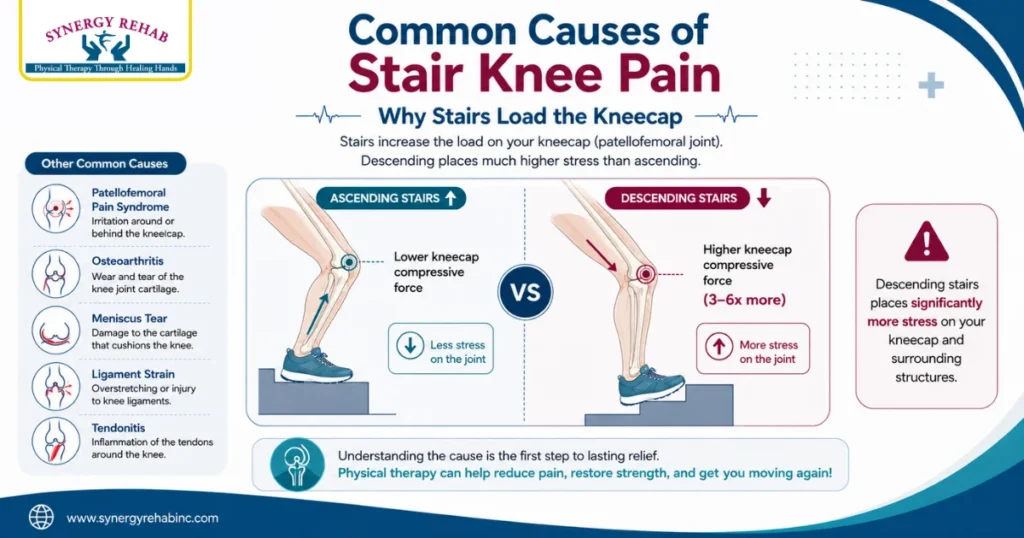
The most common culprit is patellofemoral pain syndrome, where the kneecap does not glide smoothly and irritates the tissue behind it. This often shows up as anterior knee pain, felt at the front of the knee. We also see it with:
- Weak Hip and Thigh Muscles: that let the kneecap track poorly.
- Cartilage Wear or Early Arthritis: that stairs aggravate.
- Tendon Overload: from a recent spike in activity.
- Old Injuries: that changed how you move.
Going Up vs Going Down
The direction matters. Going up is mostly a strength demand, so knee pain going up stairs often flags weak muscles. Going down is a control demand, because your muscles must lengthen under load to lower you gently. That is why knee pain downstairs is often sharper and more common. The good news is that both respond well to the right strengthening, done in the right way.
| Expert Insight: Descending Loads the Kneecap Most. Going down stairs places some of the highest routine loads on the kneecap, which is why it is often the first place stair pain appears and the last to fully settle. Targeted strengthening changes that. Sources: American Academy of Orthopaedic Surgeons. |
How Physical Therapy Helps
Good stair knee pain treatment is active. We calm the irritated kneecap, then rebuild strength in the thigh and hip so the knee tracks and absorbs load well. Simple knee rehabilitation exercises, like controlled step-downs, sit-to-stands, and hip strengthening, retrain the knee for stairs specifically. Most people climb more comfortably within a few weeks, and the gains last because we fix the cause.
How a Physical Therapist in Southfield Can Help
You do not need a referral to start. At Synergy Rehab, we deliver physical therapy for knee pain in Southfield that pinpoints why stairs hurt and rebuilds the knee for them. We explain what we find in clear terms and give you a plan you can actually follow at home.
Ready to Climb Without Pain?
If stairs have become the hardest part of your day, a short course of physical therapy can change that. Book a knee assessment with Synergy Rehab today.
Call (248) 298-0433, or visit synergyrehabinc.com. You will find us at Farmbrook Medical Building 2, 29877 Telegraph Rd, Suite 303, Southfield, MI, open Monday to Friday. No physician referral is needed to get started in Michigan.
FAQs About Knee Pain on Stairs
Q1. Why Does My Knee Hurt More Going Down Stairs?
Descending loads the kneecap and joint surfaces harder than climbing, because your muscles must control your body weight against gravity. A knee short on strength or control feels this most, so knee pain downstairs is often sharper. Targeted strengthening usually eases it.
Q2. What Is Patellofemoral Pain Syndrome?
Patellofemoral pain syndrome is pain around or behind the kneecap, often felt as anterior knee pain, when the kneecap does not glide smoothly. Stairs, squatting, and long sitting tend to aggravate it. Physical therapy resolves most cases with targeted strengthening and movement retraining.
Q3. Are Stairs Bad for Bad Knees?
Not usually. Stairs feel hard because they load the knee more, but avoiding them entirely tends to weaken the knee further. The better path is to build the strength and control the knee needs, so stairs become a form of training rather than a threat.
Q4. What Exercises Help Knee Pain on Stairs?
Controlled step-downs, sit-to-stands, and hip and thigh strengthening are among the most effective. The key is the right dose and good form, which a physical therapist tailors to you. Done consistently, these knee rehabilitation exercises make stairs noticeably easier within weeks.
Q5. When Should I See a Physical Therapist for Stair Knee Pain?
See one if the pain lasts more than a week or two, keeps returning, swells, or makes the knee feel unstable. Early care usually means a faster recovery. In Michigan you can book directly, without a physician referral.
Q6. Do I Need a Referral to Start Physical Therapy?
No. Michigan has direct access, so you can start physical therapy for knee pain without a physician referral. You can book with us directly and begin your assessment right away. It is worth checking your insurance coverage before your first visit.