The Short Answer
| Most knee pain improves without surgery. For the majority of people, exercise-based physical therapy is the first-line knee pain treatment, easing pain and rebuilding strength over weeks to months. Imaging is not always needed early, and many injuries and arthritic knees respond well to guided rehab. Surgery is reserved for specific cases, decided with your clinician. |
Your Knees Do Not Have to Slow You Down
It often starts quietly. A twinge going down the stairs. An ache after a walk that used to feel easy. A deep stiffness when you stand up from a chair. For a huge number of adults, that is the beginning of knee pain, one of the most common reasons people limit the activities they love.
Here is the part that surprises people most. The great majority of knee problems improve without an operation. We see it every week at Synergy Rehab in Southfield, where people arrive worried about surgery and leave with a plan built on movement and strength instead. This guide walks you through what causes knee pain, how it is diagnosed, and the treatment and recovery options that do not start with a scalpel. Consider this your complete guide to physical therapy for knee pain in Southfield.
What Causes Knee Pain?
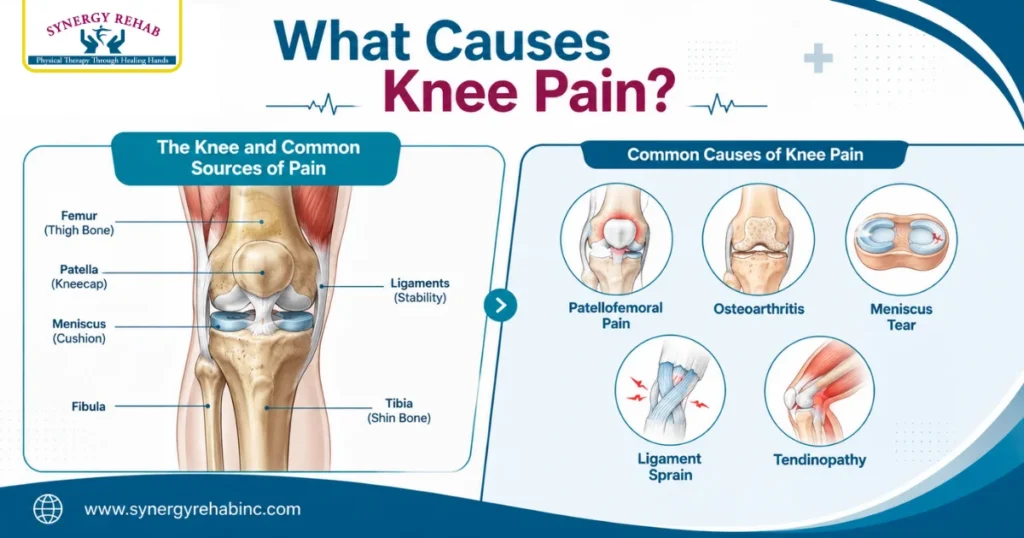
Knee pain causes fall into a few broad groups. There is wear and arthritis, where the cartilage that cushions the joint thins over time. There are injuries, such as meniscus tears, ligament sprains, and kneecap problems. And there is overload, where tendons and muscles are pushed harder or faster than they are ready for.
Age, past injuries, weak or tight muscles around the hip and thigh, and sudden spikes in activity all raise the risk. Because the knee sits between the hip and the ankle, a problem above or below often shows up as knee pain. Pinpointing your particular pattern is the first step toward lasting knee pain relief. Sorting out your knee pain causes early helps prevent small issues from becoming chronic knee pain.
Acute vs Chronic Knee Pain
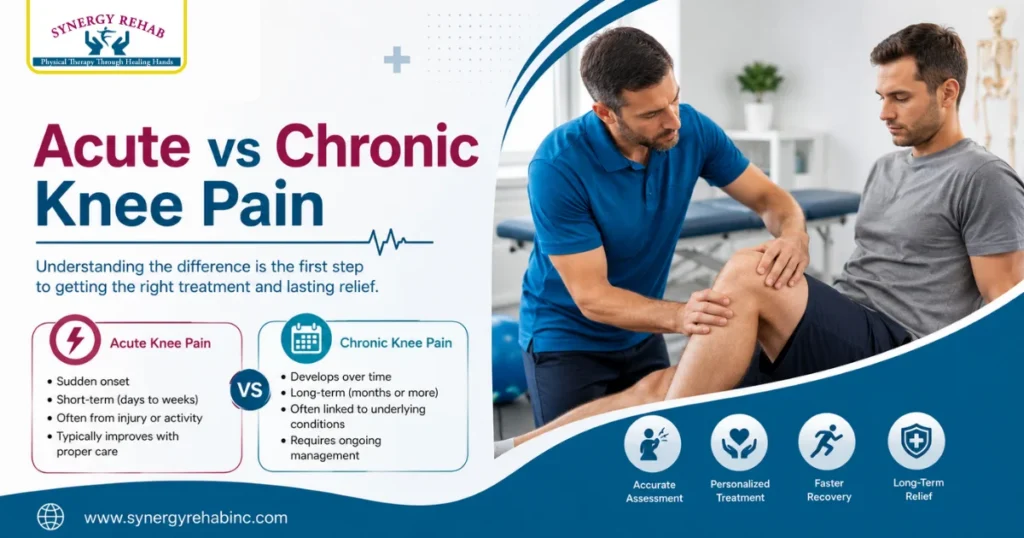
Not all knee pain is the same. Acute knee pain comes on suddenly, often after a specific twist, fall, or awkward landing, and it may bring swelling or a feeling of instability. Chronic knee pain builds gradually and lingers for weeks or months, often from arthritis, repetitive load, or an old injury that never fully settled. The two are handled differently. Acute knee pain focuses first on calming swelling and protecting the joint, while chronic knee pain leans on progressive strengthening and changing the loads that keep it going. Knowing which one you have shapes the whole plan. Either way, targeted knee injury rehabilitation restores strength and confidence.
How Is Knee Pain Diagnosed?
Good knee care starts with a conversation and a hands-on exam, not a scan. We want to know when the pain started, what makes it worse, whether it swells, catches, or gives way, and what you can and cannot do. Then we test the knee directly, its movement, strength, stability, and which activities reproduce your pain. Those findings tell us a great deal about what is going on and how irritable the joint is. Imaging has its place, but it is rarely the first step. A clear picture turns guesswork into effective knee pain relief.
| Expert Insight: Scans Can Mislead. Meniscus wear and arthritic changes show up on the scans of plenty of people who have no pain at all, and they become more common with age. A picture does not always explain your symptoms, which is why we start with a clinical exam. Sources: American Academy of Orthopaedic Surgeons; NIH NIAMS. |
Knee Pain Treatment Without Surgery
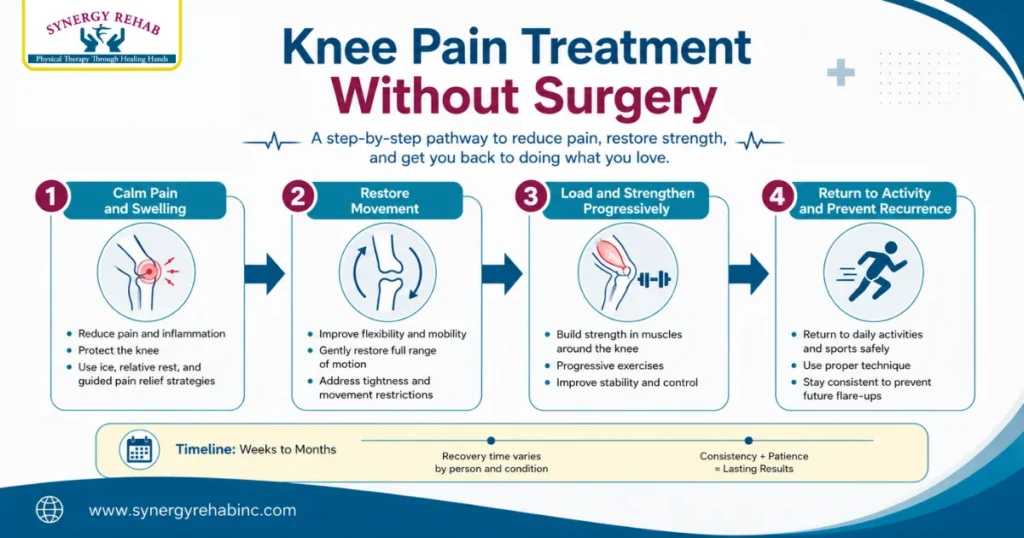
Here is the reassuring reality. For most people, knee pain treatment does not involve an operating room. Exercise-based physical therapy is the first-line approach for the majority of knee problems, and it works by doing something a scan never can, which is changing how your knee loads, moves, and tolerates activity. Effective non-surgical knee pain treatment usually blends a few things.
We calm the joint with activity adjustments and, early on, gentle movement. We build strength in the muscles that support and align the knee, especially around the thigh and hip. We restore full motion and control. And we coach the daily habits that either help or hinder recovery. Good care is active, specific, and paced to you. Done well, non-surgical knee pain treatment restores pain-free movement for the long term.
Why Rest Alone Is Not Enough
Resting a sore knee feels sensible, and a short break from aggravating activity does help early on. But long rest tends to backfire. The muscles that protect the knee weaken quickly, the joint gets stiff, and the pain often returns the moment you go back to normal life. The knee does not need to be protected into weakness. It needs to be rebuilt. That is the whole idea behind loading it gradually rather than avoiding it. This is why active care beats rest for both acute knee pain and chronic knee pain.
| Expert Insight: Movement Is the Treatment. Clinical guidance for knee osteoarthritis and many knee injuries points to exercise and progressive loading as the core of non-surgical care, with hands-on therapy as a useful add-on. Rest by itself is not a treatment plan. Sources: Journal of Orthopaedic and Sports Physical Therapy; American Physical Therapy Association. |
The Benefits of Physical Therapy for Knee Pain
The benefits go well beyond short-term knee pain relief. Physical therapy reduces pain, restores movement, and rebuilds the strength and control that keep the knee stable, which lowers the odds of the problem returning. It can help you avoid or delay surgery, reduce reliance on pain medication, and get you back to walking, stairs, work, and sport with confidence.
Just as important, you learn how your knee works and what to do when a flare happens. Many of these gains come from simple, well-chosen movements you can do at home, which we cover in our guide to exercises that reduce knee pain at home. For many people, physical therapy for knee pain in Southfield is the turning point toward lasting knee pain relief.
When Is Knee Surgery Actually Considered?
Surgery has a real role, just a narrower one than many people expect. We tend to discuss it when there is a large, unstable ligament tear, a locked knee from a displaced meniscus fragment, or advanced arthritis that has not responded to a well-run course of physical therapy over a reasonable time. Even then it is a shared decision, weighed against your goals, your health, and what rehab has already achieved.
For many people, including plenty with arthritis or a meniscus tear, non-surgical care is where we start and often where we finish. We explore this in depth in our guide on whether physical therapy can help you avoid knee surgery. Even here, non-surgical knee pain treatment usually comes first.
Knee Pain Recovery: What to Expect
Knee injury rehabilitation is a gradual process, not a switch that flips. Timelines vary with the cause, your age, your general health, and how consistent you can be with your program. As a general guide, an irritated tendon or a mild flare may settle over several weeks, while rebuilding full strength after a significant injury or surgery can take a few months. Progress is rarely a straight line. Good days and flare-ups both happen, and neither means the plan is failing. What matters is the overall trend, and steady, well-dosed work is what moves it. Patient, progressive knee injury rehabilitation is what delivers lasting results.
The table below compares common knee conditions at a glance. Treat the ranges as general. Your own timeline is confirmed at assessment.
| Condition | What It Is | Typical First-Line Care | General Recovery Range |
|---|---|---|---|
| Patellofemoral Pain | Kneecap-related pain, often on stairs | Strengthening and movement retraining | Several weeks to a few months |
| Knee Osteoarthritis | Cartilage wear in the joint | Exercise, strengthening, load management | Ongoing, often improves in weeks |
| Meniscus Tear | A tear in the knee’s cartilage cushion | Guided physical therapy for many tears | Weeks to months, varies widely |
| Ligament Sprain | An overstretched or torn ligament | Progressive rehab, surgery in select cases | Weeks to months, varies |
| Patellar Tendinopathy | An irritated, overloaded tendon | Activity tweaks, then progressive loading | Several weeks to a few months |
Why Knee Pain Often Flares on Stairs and When Bending
Two of the most common questions we hear are why the knee hurts on stairs and why it aches when bending or squatting. Both load the kneecap and the joint surfaces more than flat walking does, so they often reveal a knee that is short on strength or control. It is usually a signal, not a reason to panic, and it is one of the first things good treatment tends to improve. We break these down in our guides on knee pain on stairs and why your knee hurts when bending.
Common Knee Injuries and Sensations
Knees are busy joints, so certain injuries and sensations come up again and again. Runners often develop knee pain from training spikes and benefit from a guided return, which we cover in our guide to knee pain after running. Twisting injuries raise the question of a meniscus tear or an ACL injury, two very different problems we compare in a dedicated guide. And many people worry about a knee that pops or clicks, which is usually harmless but occasionally worth checking. If a sensation comes with pain, swelling, or instability, it is worth an assessment.
How a Physical Therapist in Southfield Can Help
You do not need a referral to start. In Michigan, you can see a physical therapist directly, which means you can begin working on your knee sooner rather than waiting on paperwork. At Synergy Rehab, we assess the whole leg, explain what we find in clear terms, and build a plan around your life and your goals. The result is expert physical therapy for knee pain in Southfield that treats the cause, not just the symptom. Most people leave the first visit understanding what is going on and what to do about it. That is the promise of our knee pain treatment approach.
Ready to Get Your Knees Moving Again?
If knee pain is limiting your walks, your stairs, your workouts, or your work, you do not have to wait it out or assume surgery is the only answer. Our team will assess your knee, explain your options, and start you on a plan that fits your life and gets you real knee pain relief. Book a knee assessment with Synergy Rehab today.
Call (248) 298-0433, or visit synergyrehabinc.com. You will find us at Farmbrook Medical Building 2, 29877 Telegraph Rd, Suite 303, Southfield, MI, open Monday to Friday. No physician referral is needed to get started in Michigan.
FAQs About Knee Pain Treatment
Q1. What Is the Best Treatment for Knee Pain?
For most knee pain, the best first step is active, exercise-based physical therapy that targets the cause, paired with hands-on care and load management. It usually beats long rest, which stiffens the joint. Non-surgical knee pain treatment resolves the majority of cases without injections or surgery.
Q2. What Causes Knee Pain Without an Injury?
Knee pain without a clear injury often comes from arthritis, kneecap tracking problems, tendon overload, or weakness in the muscles around the hip and thigh. Everyday load, like stairs and squatting, then reveals it. A physical therapy assessment pinpoints the specific cause so the right plan can address it.
Q3. Can Physical Therapy Relieve Chronic Knee Pain?
Yes. For most people, physical therapy eases chronic knee pain by rebuilding strength, restoring movement, and reducing the loads that keep the joint irritated. It treats the cause rather than masking it, which is why relief tends to last. Even long-standing arthritis often improves with the right program.
Q4. How Long Does Knee Pain Take to Recover?
It varies by cause and severity. A mild flare may settle in several weeks, while recovering from a significant injury or surgery can take a few months. Your therapist reassesses as you improve and adjusts the plan. Much of the progress comes from the exercises you do at home between visits.
Q5. Can Physical Therapy Help Me Avoid Knee Surgery?
Often, yes. Many people with arthritis, meniscus tears, or kneecap pain improve enough with physical therapy that surgery is delayed or avoided. Non-surgical knee pain treatment is usually the recommended first step. Surgery is reserved for specific cases and is a shared decision with your clinician.
Q6. Should I Rest or Exercise for Knee Pain?
A short rest helps in the first day or two after a flare, but long rest tends to backfire by weakening the muscles that protect the knee. Guided, progressive exercise is the core of recovery. The key is the right movements at the right dose, which is what a physical therapist provides.
Q7. When Should I See a Physical Therapist for Knee Pain?
See a physical therapist if knee pain lasts more than a week or two, keeps returning, follows an injury, swells, or makes the knee feel unstable. Early care often means a faster recovery. In Michigan you can book directly, without a physician referral, so there is no reason to wait.
Q8. Do I Need a Referral to See a Physical Therapist in Michigan?
No. Michigan has direct access, so you can start physical therapy for knee pain without a physician referral. You can book with us directly and begin your assessment right away. Some insurance plans have their own rules, so it is worth checking your coverage before your first visit.