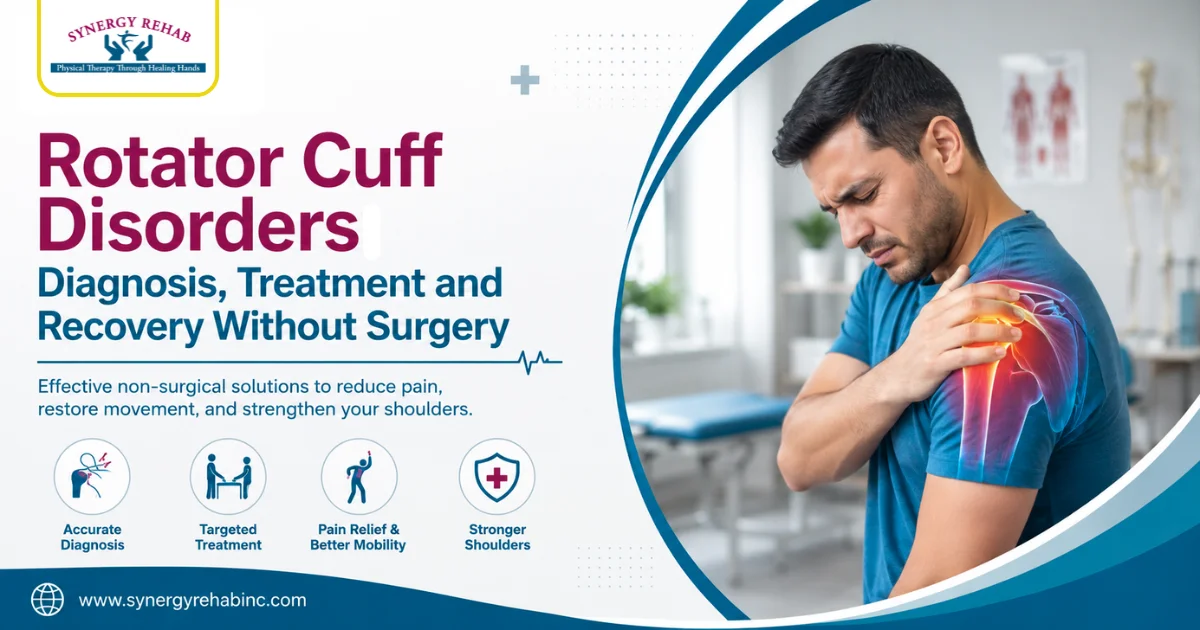
| Most rotator cuff disorders improve without surgery. For the majority of people, exercise-based physical therapy is the first-line treatment, easing pain and rebuilding strength over weeks to months. Imaging is not always needed early, and many tears respond well to guided rehab. Surgery is reserved for specific cases, decided with your clinician. |
Your Shoulder Does Not Have to End Up on an Operating Table
It usually starts small. A twinge when you reach for the seatbelt. An ache when you lift a bag into the overhead bin. A dull throb that wakes you at 2am the moment you roll onto that shoulder. For a huge number of adults, that is the quiet beginning of one of the rotator cuff disorders, the most common source of ongoing shoulder pain in adults.
Here is the part that surprises people most. The great majority of these problems get better without an operation. We see it every week at Synergy Rehab in Southfield, where people arrive worried they are headed for surgery and leave with a plan built on movement and strength instead. This guide walks you through what these conditions actually are, how they are diagnosed, and the treatment and recovery options that do not start with a scalpel.
What Are the Rotator Cuff Disorders?
Your rotator cuff is a team of four muscles and their tendons that wrap around the top of your arm bone and hold it snugly in the shoulder socket. They do quiet, constant work, steadying the joint so your bigger muscles can lift, reach, and throw. When one of those tendons gets irritated, overloaded, or torn, the whole shoulder can protest.
The term rotator cuff disorders covers a spectrum, not a single injury. At the milder end sits tendinopathy, an irritated and overworked tendon. Impingement, sometimes called subacromial pain, happens when the tendons get compressed as you lift the arm. Then there are tears, which range from small partial ones to full-thickness tears that go all the way through the tendon. These conditions often overlap, and the same person can have more than one at once. What matters most is not the exact label. It is how your shoulder feels and what it can do.
How Are Rotator Cuff Disorders Diagnosed?

Good rotator cuff diagnosis starts with a conversation and a physical exam, not a scan. We want to know when the pain started, what makes it worse, whether it wakes you at night, and what you can and cannot do with the arm. Then we test the shoulder directly. How far it moves, how strong it is in specific positions, and which movements reproduce your pain. Those hands-on tests tell us a great deal about which tendons are involved and how irritable the shoulder is.
Imaging has its place, but it is rarely the first step. That surprises people, so it is worth explaining why.
| Expert Insight: Scans Can Mislead. Rotator cuff changes, and even tears, are common on MRI in people who have no pain at all, and they grow more common with age. A scan finding does not automatically explain your symptoms, which is why we start with a clinical exam. Sources: American Academy of Orthopaedic Surgeons; NIH NIAMS. |
This is the heart of a modern rotator cuff diagnosis. An MRI can show a tear that is not the real cause of your pain, and it can pull treatment toward the picture rather than the person. We generally reserve imaging for cases where the exam points to a significant tear, where symptoms are not improving as expected, or where surgery is genuinely on the table. For most people, we can build an effective plan without it.
Rotator Cuff Treatment Without Surgery

Here is the reassuring reality. For most people, rotator cuff treatment does not involve an operating room. Exercise-based physical therapy is the first-line approach for the majority of rotator cuff disorders, and it works by doing something a scan never can, which is changing how your shoulder loads, moves, and tolerates activity.
Effective rotator cuff physical therapy usually blends a few things. We calm the irritated tendon with activity adjustments and, early on, gentle movement. We then load it progressively, because tendons get stronger and less painful when they are challenged in the right dose. We address the shoulder blade, the neck, and posture, since the cuff never works alone. And we coach you on the daily habits, including sleep position and overhead activity, that either help or hinder recovery. Good shoulder pain treatment is active, specific, and paced to you.
Why Rest Alone Is Not Enough
Resting a sore shoulder feels sensible, and a short break from aggravating activity does help early on. But long rest tends to backfire. Tendons and muscles weaken when they are not used, the shoulder gets stiff, and the pain often returns the moment you go back to normal life. The tendon does not need to be protected into weakness. It needs to be rebuilt. That is the whole idea behind loading it gradually rather than avoiding it.
| Expert Insight: Movement Is the Treatment. Clinical guidance for rotator cuff-related shoulder pain points to exercise and progressive loading as the core of non-surgical care, with hands-on therapy as a useful add-on. Rest by itself is not a treatment plan. Sources: Journal of Orthopaedic and Sports Physical Therapy; American Physical Therapy Association. |
What About Exercises for the Rotator Cuff?
The right exercises are the engine of recovery. Early on, they are gentle and often pain-free by design. As the shoulder settles, they build up. Resistance bands, light weights, and movements that rebuild the strength you use for reaching and lifting. The wrong exercises, or the right ones done too soon or too hard, can flare things up, which is why the plan matters as much as the moves. We break down specific movements, and the ones to avoid, in our dedicated guide to the best exercises for rotator cuff pain.
When Is Surgery Actually Considered?
Surgery has a real role, just a narrower one than many people expect. We tend to discuss it when there is a large, acute tear from a specific injury, especially in a younger or highly active person, when a full-thickness tear significantly weakens the arm, or when a well-run course of physical therapy has not delivered enough progress over a reasonable time. Even then, it is a shared decision, weighed against your goals, your health, and what rehab has already achieved. For the many people with tendinopathy, impingement, or smaller tears, non-surgical care is usually where we start and often where we finish.
Rotator Cuff Recovery: What to Expect
Rotator cuff recovery is a gradual process, not a switch that flips. Timelines vary with the condition, your age, your general health, and how consistent you can be with your program. As a general guide, an irritated tendon may settle over several weeks to a few months, while rebuilding full strength and confidence can take longer. Progress is rarely a straight line. Good days and flare-ups both happen, and neither means the plan is failing. What matters is the overall trend, and steady, well-dosed work is what moves it.
The table below compares the common conditions at a glance. Treat the ranges as general. Your own timeline is confirmed at assessment.
| Condition | What It Is | Typical First-Line Care | General Recovery Range |
|---|---|---|---|
| Tendinopathy | An irritated, overloaded tendon | Activity tweaks, then progressive loading | Several weeks to a few months |
| Impingement | Tendons compressed on lifting the arm | Movement retraining and strengthening | Several weeks to a few months |
| Partial Tear | A tear through part of the tendon | Guided physical therapy and loading | Weeks to months, varies widely |
| Full-Thickness Tear | A tear through the whole tendon | PT first for many, surgery in select cases | Months, longer if surgery is chosen |
Ranges are general and vary by person. Your timeline is confirmed at assessment.
Why Shoulder Pain Often Feels Worse at Night
One of the most common questions we hear is why the shoulder throbs at night. Lying down shifts the pressure and blood flow around the joint, rolling onto the shoulder compresses irritated tendons, and there are simply fewer distractions from the pain after dark. Night pain is a classic feature of rotator cuff problems, and it is one of the first things good treatment tends to improve. Small changes to your sleep position can make a real difference while the tendon heals, which we cover in our guide on why shoulder pain gets worse at night.
How a Physical Therapist in Southfield Can Help
You do not need a referral to start. In Michigan, you can see a Physical Therapist in Southfield directly, which means you can begin working on your shoulder sooner rather than waiting on paperwork. At Synergy Rehab, we assess the whole shoulder, explain what we find in clear terms, and build a plan around your life and your goals. Most people leave the first visit understanding what is going on and what to do about it. That clarity, paired with the right exercises, is what turns a nagging shoulder back into a working one.
Ready to Get Your Shoulder Moving Again?

If shoulder pain is limiting your reach, your sleep, or your workouts, you do not have to wait it out or assume surgery is the only answer. Our team will assess your shoulder, explain your options, and start you on a plan that fits your life. Book a shoulder assessment with Synergy Rehab today.
Call (248) 298-0433, or visit synergyrehabinc.com. You will find us at Farmbrook Medical Building 2, 29877 Telegraph Rd, Suite 303, Southfield, MI, open Monday to Friday. No physician referral is needed to get started in Michigan.
FAQs About Rotator Cuff Disorders
Q1. Can rotator cuff disorders heal without surgery?
Yes. For most people, rotator cuff disorders improve without surgery. Exercise-based physical therapy is the first-line treatment, easing pain and rebuilding strength over weeks to months. Surgery is reserved for specific cases, such as large tears from an injury or when quality rehab has not delivered enough progress.
Q2. How long does rotator cuff recovery take?
Rotator cuff recovery is gradual and varies by person. An irritated tendon often settles over several weeks to a few months, while rebuilding full strength can take longer. Your age, health, and consistency with your program all shape the timeline, which your therapist confirms at assessment.
Q3. Do I need an MRI for shoulder pain?
Often, no. Most shoulder problems are diagnosed with a conversation and a physical exam, not a scan. MRI changes are common even in people without pain, so a scan can mislead. We usually reserve imaging for suspected significant tears, slow progress, or when surgery is being considered.
Q4. What is the difference between a rotator cuff tear and tendinitis?
Tendinitis, more accurately tendinopathy, is an irritated, overworked tendon. A tear is actual damage through part or all of the tendon. They can feel similar and often overlap, so a clinical exam, not just a scan, helps tell them apart and guide the right plan.
Q5. Is it bad to exercise a painful rotator cuff?
Not when it is done right. Gentle, well-dosed exercise is the core of recovery, because tendons get stronger and less painful when loaded appropriately. The key is the correct exercises at the correct intensity. Sharp or lasting pain is a sign to adjust, so guidance helps early on.
Q6. Why does my shoulder hurt more at night?
Night pain is a classic feature of rotator cuff problems. Lying down shifts pressure and blood flow around the joint, rolling onto the shoulder compresses irritated tendons, and there are fewer distractions after dark. Adjusting your sleep position often helps while the tendon heals.
Q7. When should I consider rotator cuff surgery?
Surgery is usually considered for a large tear from a specific injury, a full-thickness tear that significantly weakens the arm, or when a well-run course of physical therapy has not delivered enough progress. It is a shared decision, weighed against your goals, health, and rehab results.
Q8. Do I need a referral to see a physical therapist in Michigan?
No. In Michigan, you can see a Physical Therapist in Southfield directly, without a physician referral, to begin assessment and treatment. This direct access means you can start working on your shoulder sooner. Some insurance plans have their own rules, so it is worth checking your coverage.