



The Short Answer
| The best neck pain exercises combine gentle mobility to ease stiffness with strengthening for the neck and upper back. Chin tucks, neck rotations, and shoulder blade squeezes are safe starting points. Move slowly, stay within comfort, and stop any move that sharpens pain or sends symptoms into the arm. |
Move Your Way Out of Neck Pain
When your neck is sore, moving it feels like the last thing you should do. In fact, gentle movement is one of the best things you can do. The right moves ease stiffness, restore range, and build the strength that keeps the pain from coming back. You don’t need equipment, and you can do most of these at home. Move slowly, breathe, and stop any move that sharpens your pain or sends symptoms down the arm. For a full look at causes and treatment, read our complete guide to neck pain relief.
| Expert Insight: Gentle and Consistent Wins. For most neck pain, a little movement most days works better than occasional hard stretching. Progressive, comfortable exercise is what rebuilds a strong, mobile neck. Sources: Journal of Orthopaedic and Sports Physical Therapy. |
10 Neck Pain Exercises to Try
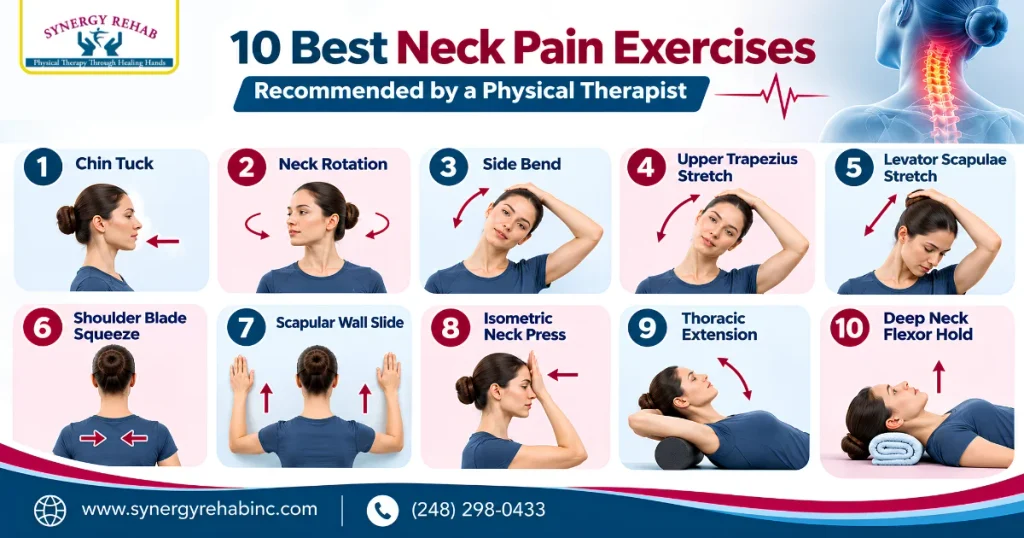
Start with what feels manageable and build up over a couple of weeks. These physical therapy exercises for neck pain work together as mobility, stretch, and strength:
- 1. Chin Tuck: Gently draw the chin straight back, making a double chin, and hold briefly.
- 2. Neck Rotation: Turn your head slowly to look over each shoulder, within comfort.
- 3. Side Bend: Tilt one ear toward the shoulder for a gentle side-of-neck stretch.
- 4. Upper Trapezius Stretch: Ease the head to one side while the opposite hand reaches down.
- 5. Levator Scapulae Stretch: Turn the head toward the armpit and gently look down.
- 6. Shoulder Blade Squeeze: Draw the shoulder blades together and down, then release.
- 7. Scapular Wall Slide: With your back to a wall, slide the arms up and down with control.
- 8. Isometric Neck Press: Press the head lightly into your hand without moving, to build strength.
- 9. Thoracic Extension: Gently arch the upper back over a chair to offset a rounded posture.
- 10. Deep Neck Flexor Hold: A soft chin tuck held in lying, to train the deep support muscles.
Add Shoulder and Upper Back Work
The neck never works alone, so the best programs include neck and shoulder exercises and some upper-back strengthening. A rounded upper back and weak shoulder blades make the neck do too much, so posture and shoulder work speed recovery. Pairing these with your stiff neck exercises gives the fastest, most lasting results.
Safety First
A little muscle effort and a mild stretch are expected, but these moves should not cause sharp pain, dizziness, or symptoms shooting into the arm. If they do, ease off and get assessed. Most people can ease neck stiffness at home, but the right starting point and dose matter, and a therapist personalises both.
How a Physical Therapist in Southfield Can Help
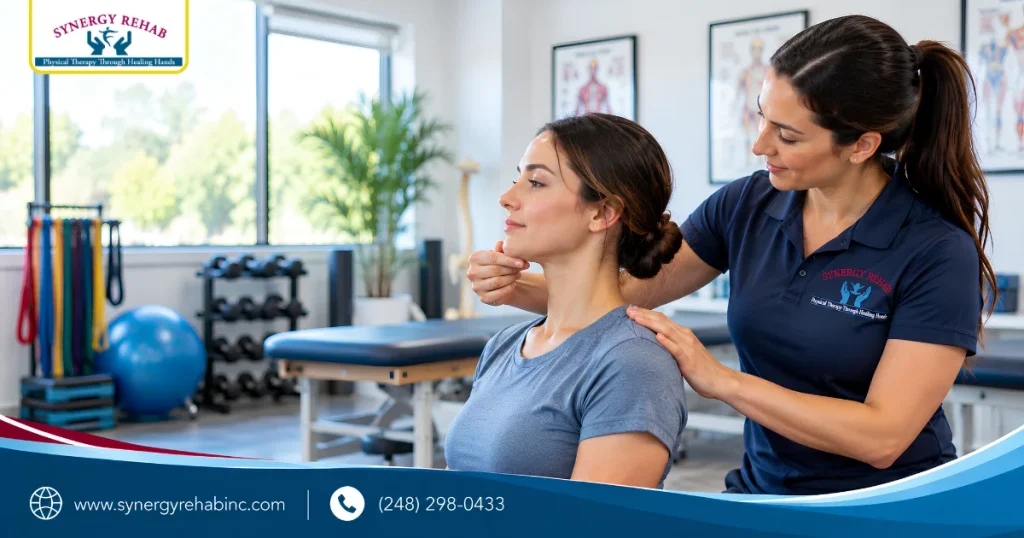
Exercises from an article are a fine starting point, but a plan built around your own neck is what really moves the needle. We’ll tailor these moves to you, fix your form, and progress you at the right pace. In Michigan, you can book directly, no referral needed, and that personalised physical therapy in Southfield turns generic exercises into real neck pain relief without surgery, as part of our neck pain treatment in Southfield.
Ready for a Plan Made for You?

Home exercises are a great start, and they work even better with a neck-specific plan. Book a neck assessment with Synergy Rehab today.
Call (248) 298-0433, email info@synergyrehabinc.com, or visit synergyrehabinc.com. You will find us at Farmbrook Medical Building 2, 29877 Telegraph Rd, Suite 303, Southfield, MI, open Monday to Friday. No physician referral is needed to get started in Michigan.
FAQs About Neck Pain Exercises
Q1. What Are the Best Neck Pain Exercises?
Gentle mobility and stretching for stiffness, plus strengthening for the neck and upper back, work best. Chin tucks, neck rotations, side bends, and shoulder blade squeezes are safe starting points. The right mix depends on your cause, so a physical therapist tailors it to you.
Q2. Can I Do Neck Pain Exercises at Home?
Yes. Most of these moves need no equipment at home, just a few minutes most days. Start gently, stay within comfort, and build up slowly. Stop any move that sharpens pain or sends symptoms into the arm, and get assessed if that happens.
Q3. How Often Should I Do Neck Exercises?
For most people, short daily sessions beat occasional hard stretching. A few minutes once or twice a day lets your neck adapt without flaring up. Consistency matters more than intensity, and your therapist can set the right frequency for your stage of recovery.
Q4. Should Neck Exercises Hurt?
Mild muscle effort and a gentle stretch are fine, but sharp pain, dizziness, or symptoms shooting into the arm are not the goal. Ease off if a move causes those. If pain keeps returning, get the neck assessed rather than pushing through.
Q5. Can Exercises Relieve Neck Pain Without Surgery?
For most people, yes. Targeted exercise, posture work, and strengthening can relieve neck pain without surgery by treating the cause. Surgery is reserved for specific nerve or structural problems. A physical therapist can confirm that exercise is right for your situation.
Q6. Do I Need a Referral to Start Physical Therapy?
No. Michigan is a direct-access state, so that you can begin physical therapy for neck pain without a physician referral. Just call (248) 298-0433, email info@synergyrehabinc.com, or book online, and we’ll get you in. It’s worth quickly checking your insurance coverage before your first visit, though.